

How To Set Up Tig Welder

Tig Welder Settings Made Simpler...1 stop shop
See Hundreds of Quick 30 second videos showing TIG welder settings for all types of Welds
TIG Welder inverters have a bunch of settings and if you don't understand what they do, yous will never get the most out of your inverter tig welding machine.
I have a friend who but had an opportunity to buy a big old Miller 330 ABP for about 500 bucks.
Those old things are Cadillac tig welders just the problem is the darn thing is every bit big as a refrigerator and weighs almost 900 pounds.
No matter how sweetness information technology welds, or how sugariness the bargain is, if you are cramped for space, dont have adequate power service for a 100 amp breaker, and don't have room for a refrigerator sized welder in your garage, its not a very skilful deal.
That's were tig inverters come up in.
With inverter technology, we tin have a 300 amp machine that can easily be carried by one person or wheeled around the shop on a light duty cart.
And the really great matter virtually tig inverters is that the arc tin can be tweaked to your liking.
Just simply if you empathize what all those freakin knobs are for.
Then allow's talk nigh the main tig welding inverter settings. Some of the settings that you need to really get a handle on are:
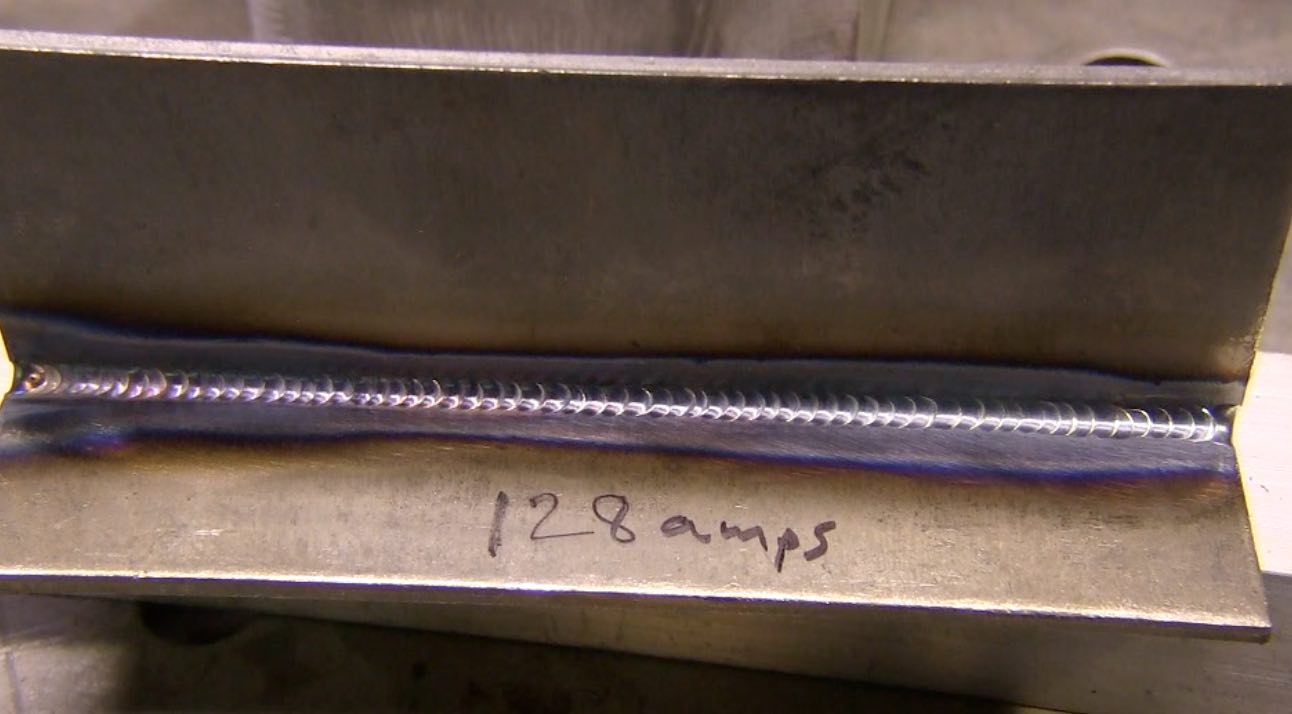
• Amperage—pretty straightforward...merely at that place is a elementary rule of thumb that holds true up to nigh .125" thick metal. (3.2mm)...mainly carbon steel
1 amp per 1 thousandths (thats almost 40 amps per mm)
A little more than 1 amp for aluminum
A little less than i amp for stainless
in one case you get thicker than .125" the 1 amp rule starts to drift and not piece of work every bit well
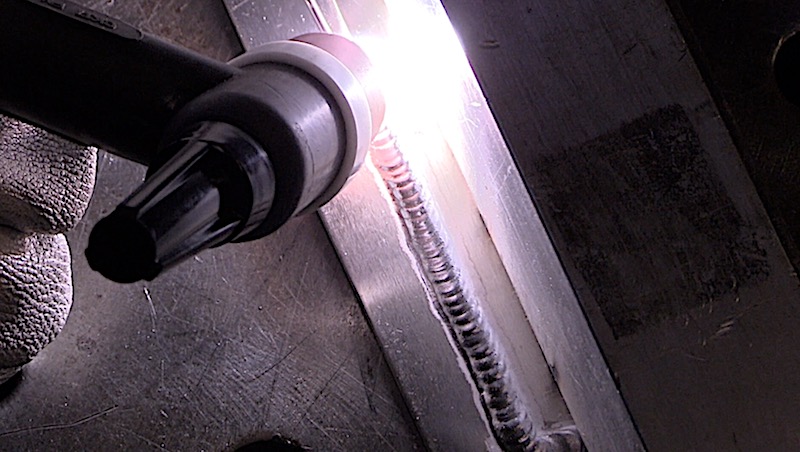
• A/C frequency—power from the ability company is roughly 60hz in the United states of america and 50 hz in some other countries.
An inverter tig welder steps the frequency of the incoming AC power upwardly before it even converts information technology to DC.
That's why the transformer is so modest light compared to an old transformer manner tig welder…the A/C frequency knob allows yous to weld with a much higher frequency.(HZ)
A college HZ frequency setting stiffens and focuses the tig welding arc..pinpoints the heat more..and sometimes that's a very adept thing…like when you need to put 1 drop of filler metallic on a pit in an aluminum injection mold. or when you demand to weld well-nigh threads and y'all don't want to arc off and damage the threads.
rule of thumb hither is lower frequency for thicker aluminum and higher frequency settings for thinner aluminum...but there are always exceptions.
• A/C residuum—Alternating current contains both electrode positive and electrode negative changing rapidly dorsum and forth.
With Old school machines, you get what you lot get and the ac current is roughly 55 /45 dcep/dcen.
The unbalance is due to something called rectification (ouch that sounds painful)…and you don't always need all that cleaning action that you get from the dcep side.
Only with most modern tig inverters, you tin can adapt the air-conditioning residual to more than than 90 % dcen.
Rule of thumb: for nasty aluminum like a boat prop that has some corrosion, adjust the ac balance to where y'all use more than dcep .
For brand new make clean aluminum diamond plate, gear up the ac residual to where you have effectually 67-75 percent dcen.
But some brands of tig welders have their AC balance knob where the college number setting indicaties more cleaning so if yous set the Ac balance knob high and your tip of your electrode melts, try a much lower setting.
• 2t ---for using a switch on the torch handle…when you plug in the pes pedal or torch amperage control, most tig inverters are designed to bypass the 2t and 4t settings because the amperage control overrides all the upslope and downslope stuff.
The 2t setting pretty much turns the torch switch into a 2 position switch. Printing the switch , you get and arc. Let off the switch, arc goes out.
uplsope and downslope tin can be set to taper up and down using 2t or 4t function
• 4t—the 4t position is most always used in conjuction with upslope and downslope settings…something like this…
1.press the push and you lot get an arc.
2 Let off the push and the arc upslopes to whatever the chief aperage is prepare to
Weld
3 Press the button and arc downslopes to lower amperage
4 Permit off the button and arc quits.
Some machines are unlike merely this is the general principle of 4t operation
• Tig high freq vs lift arc vs scratch start---tig high frequency lets you lot start the arc without touching off…the elevator arc office lets you weld without high frequency if that's important to you like if you lot are welding in an air traffic control tower….
scratch start is basically the stick setting. If yous are used to a apparently jane dry out rig, you might use scratch first.
• Pre-menstruation—the length of time the torch gas flows between the fourth dimension you printing the switch or remote foot pedal, and when you actually become an arc. No need to have more 0.five or ½ of 2nd.
• Post-period-- the length of fourth dimension the torch gas flows later the arc terminates.
• Up gradient—allows the current to climb at whatever charge per unit yous fix…from start amperage to operating master amperage setting on the machine
• Down gradient—allows the current to decrease at whatever rate you set on the knob so that you wont get out a defect like a fish eye or crater cleft
• Start amps —allows for a really low amperage startup or a hot one
• End amps—determines the final amperage before the arc quits
• Pulse frequency---pps or pulses per second…yous might recall that in one case you become above thirty pps it would be similar no pulse at all…you would exist wrong. Higher pulse rates really focus the arc.
• Pulse percentage of groundwork current or peak pulse percent—lets you control the effect of pulse to limit estrus input or just to agitate the puddle.
• Pulse % on time also called pulse width—the time the high pulse amperage stays on
Dang! Anything else!!??
leave tig welder inverter setting and encounter more tig welding tips
Source: https://www.weldingtipsandtricks.com/tig-welder-settings.html
0 Response to "How To Set Up Tig Welder"
Post a Comment